Plano-Convex Lenses
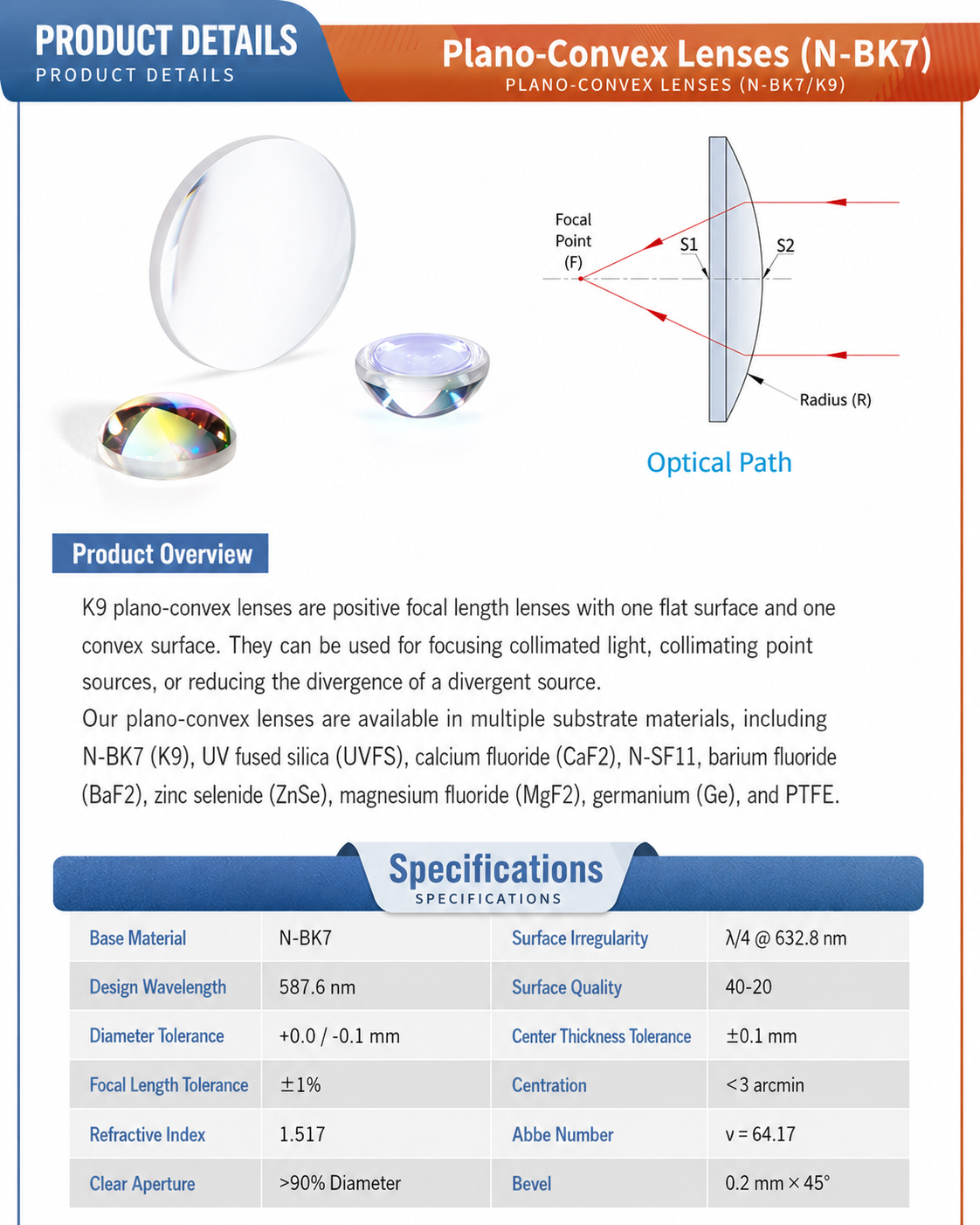
Plano-convex lenses are positive focal length lenses with one flat surface and one convex surface.
They are commonly used for focusing collimated light, collimating point light sources, beam shaping,
beam expansion and reducing the divergence of optical beams.
PHOSLENS plano-convex lenses are suitable for laboratory optics, imaging systems, laser alignment,
optical testing, optical experiments and general optomechanical applications. Standard models are available
for online purchase, and custom material, size, focal length and coating requirements can be submitted by RFQ.
Product Overview
A plano-convex lens has a positive focal length. It can focus a collimated beam to a point,
collimate light emitted from a point source, or reduce the divergence angle of a beam.
This makes plano-convex lenses a practical choice for many optical systems where simple focusing
or collimation is required.
For best performance, the lens orientation should be selected according to the optical setup.
When focusing a collimated beam, the curved surface should generally face the incident collimated light.
When collimating light from a point source, the flat surface should generally face the point source.
This orientation helps reduce spherical aberration in typical applications.
Material Naming Note
In optical component supply chains, the terms K9, H-K9,
H-K9L and N-BK7 are often used to describe similar or
equivalent borosilicate crown optical glass materials for standard visible and near-infrared optics.
The exact naming may vary by manufacturer, material standard and product series.
For PHOSLENS product pages, please refer to the model table and product specification data for the
confirmed material name, dimensional parameters and coating status. If your application requires a
specific glass standard, refractive index, Abbe number or material certificate, please submit an RFQ
before ordering.
Key Features
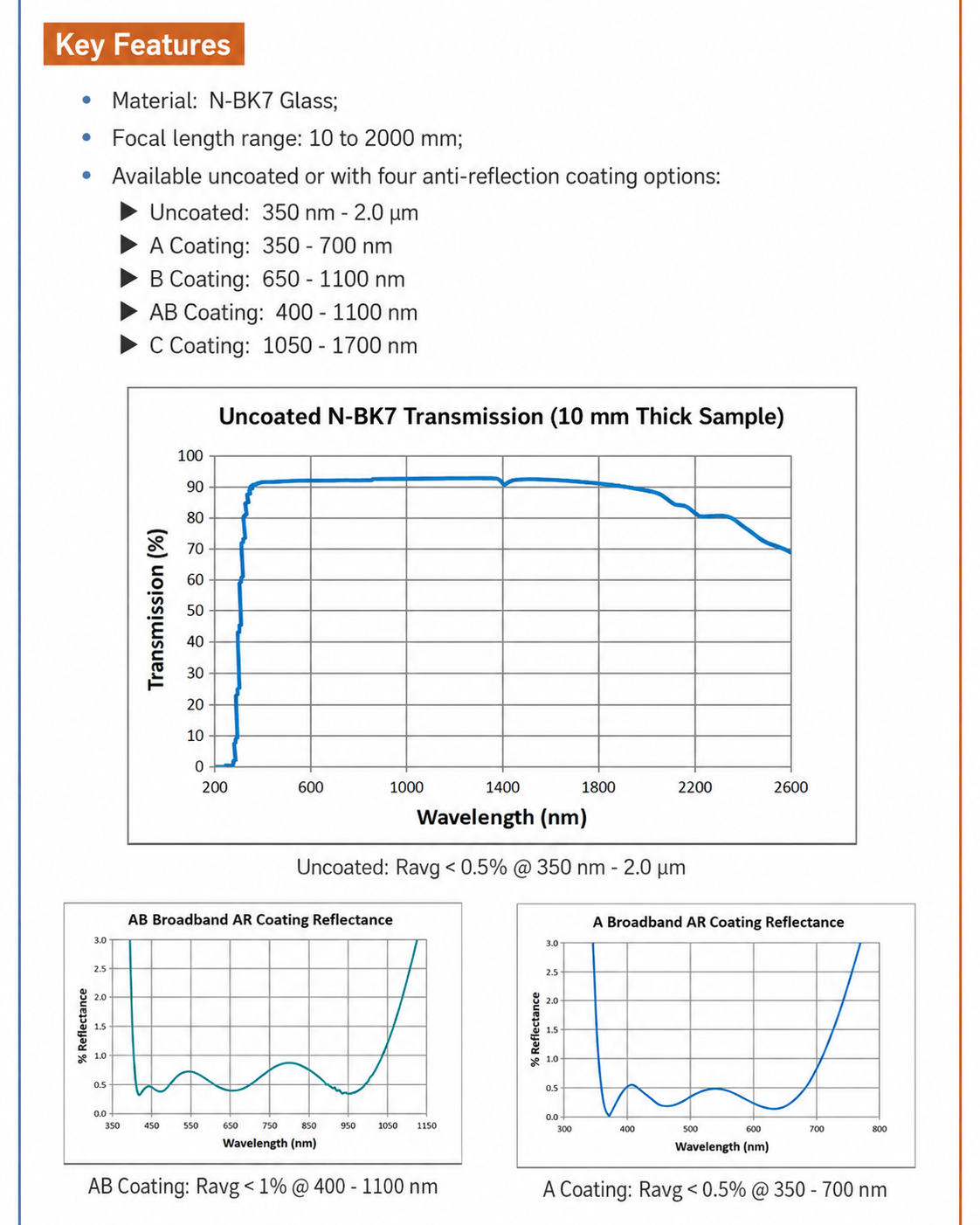
- Positive focal length spherical lens
- One flat surface and one convex surface
- Suitable for focusing, collimation, beam shaping and beam expansion
- Commonly used in laboratory, imaging, laser and optical alignment systems
- Available in standard optical glass materials such as K9 / H-K9 / H-K9L / N-BK7 type glass
- Multiple diameters and focal lengths available depending on product series
- Uncoated and broadband anti-reflection coating options may be available
- Standard models available for online purchase
- Custom specifications available by RFQ
General Specifications
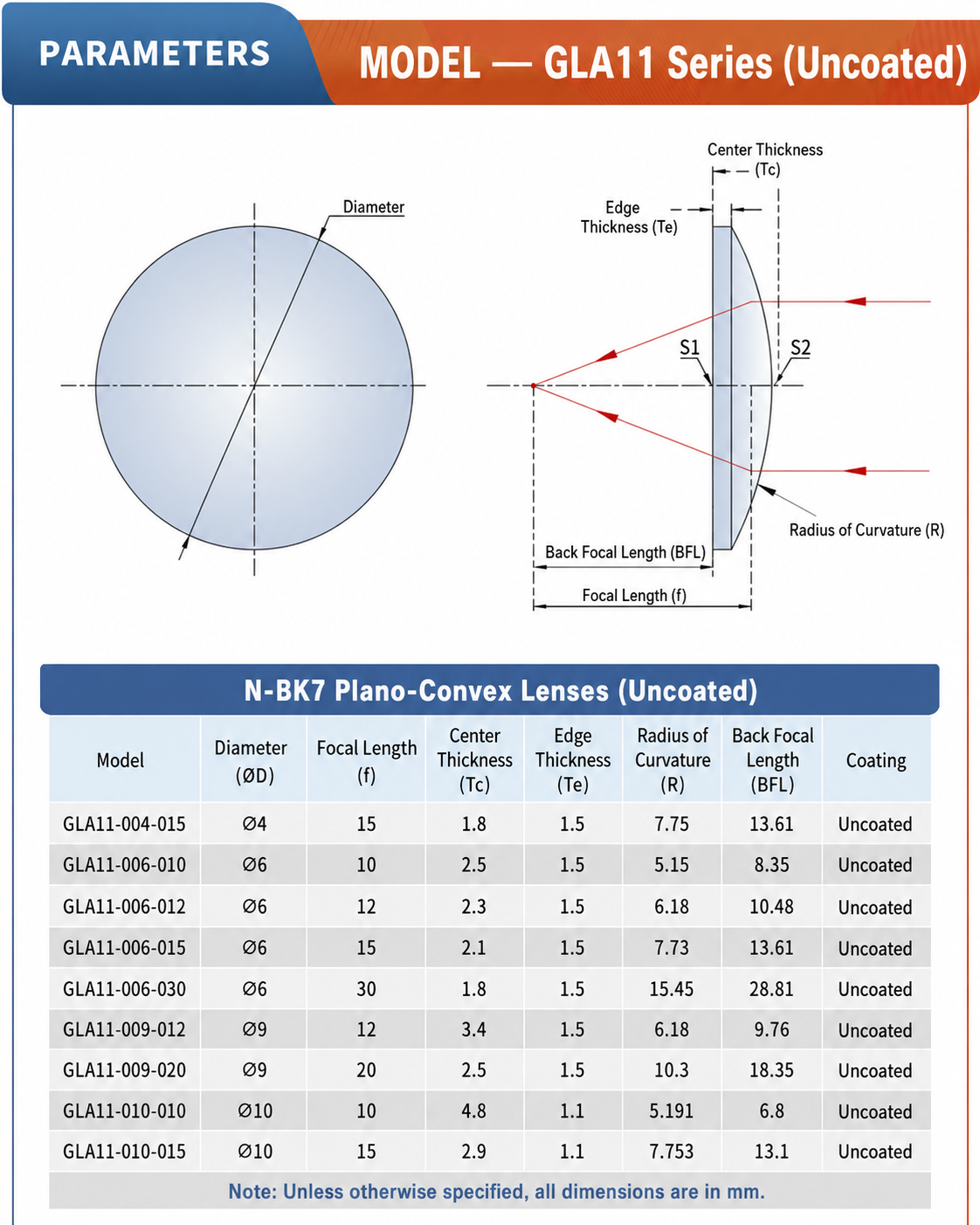
| Lens Type | Plano-Convex Lens |
| Focal Length | Positive, model-specific |
| Material | K9 / H-K9 / H-K9L / N-BK7 type optical glass, depending on product series |
| Coating | Uncoated or AR-coated options, depending on model availability |
| Diameter | Model-specific |
| Focal Length | Model-specific |
| Center Thickness | Model-specific |
| Back Focal Length | Model-specific |
| Radius of Curvature | Model-specific |
Coating Options
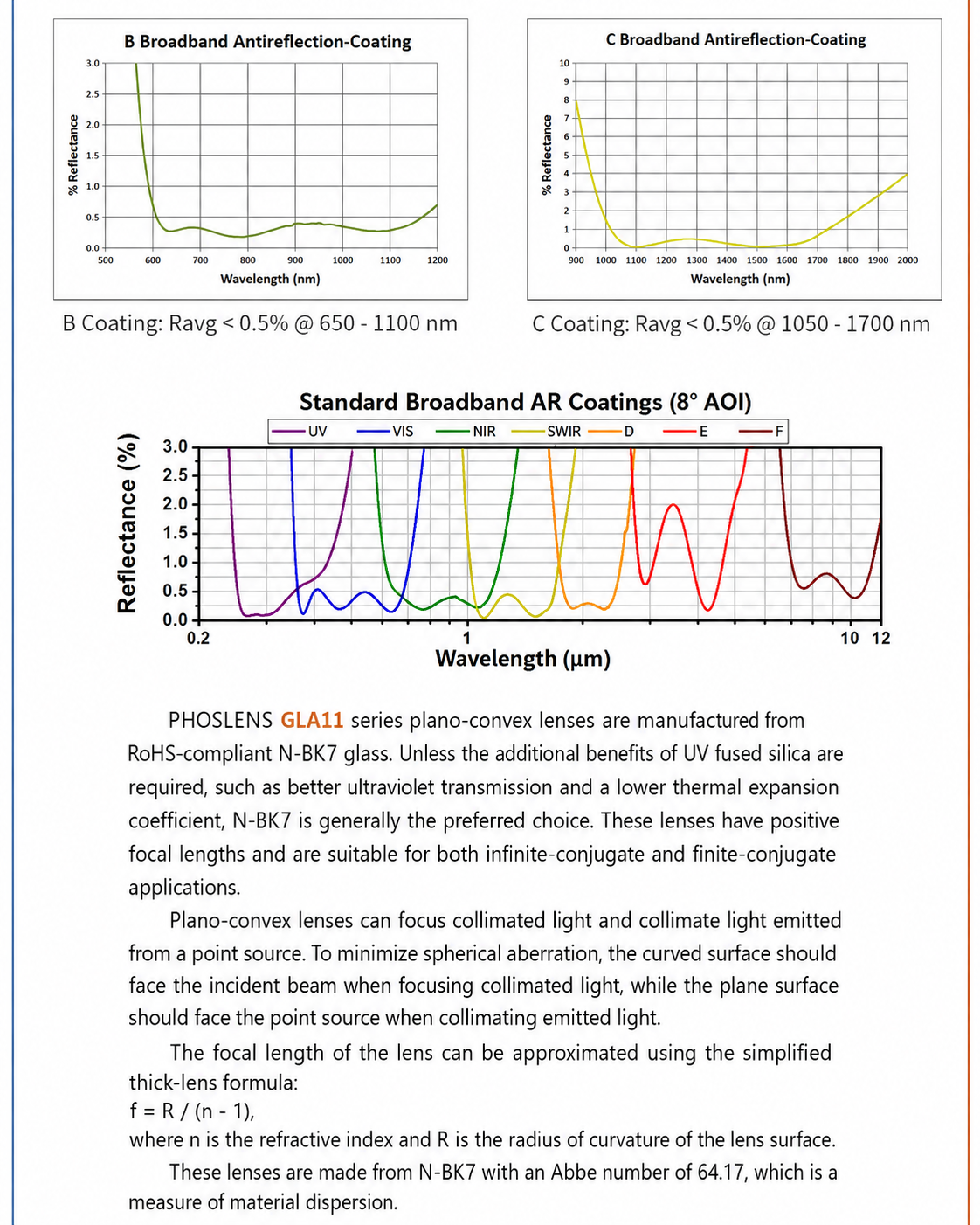
Plano-convex lenses can be supplied uncoated or with broadband anti-reflection coatings depending on
the material, wavelength range and application requirements. Anti-reflection coatings help reduce
surface reflection losses and improve transmission, especially in optical systems using multiple elements.
| Uncoated | 350 nm – 2.0 μm |
| A Coating | 350 – 700 nm |
| B Coating | 650 – 1100 nm |
| AB Coating | 400 – 1100 nm |
| C Coating | 1050 – 1700 nm |
Coating availability may vary by material, diameter and focal length. Please confirm coating requirements
before ordering or submit a custom optics RFQ for non-standard coating needs.
Optical Notes
K9 / H-K9 / H-K9L / N-BK7 type optical glass is widely used for standard visible and near-infrared
optical components. It is commonly selected when the additional ultraviolet transmission and lower
thermal expansion advantages of UV fused silica are not required.
Plano-convex lenses are well suited for applications where one conjugate distance is much longer than
the other. They can be used for both infinite-conjugate and finite-conjugate optical layouts depending
on the system design.
The focal length of a plano-convex lens can be approximated using the simplified thick-lens relationship:
f = R / (n – 1)
where f is focal length, R is the radius of curvature of the lens surface,
and n is the refractive index of the optical material.
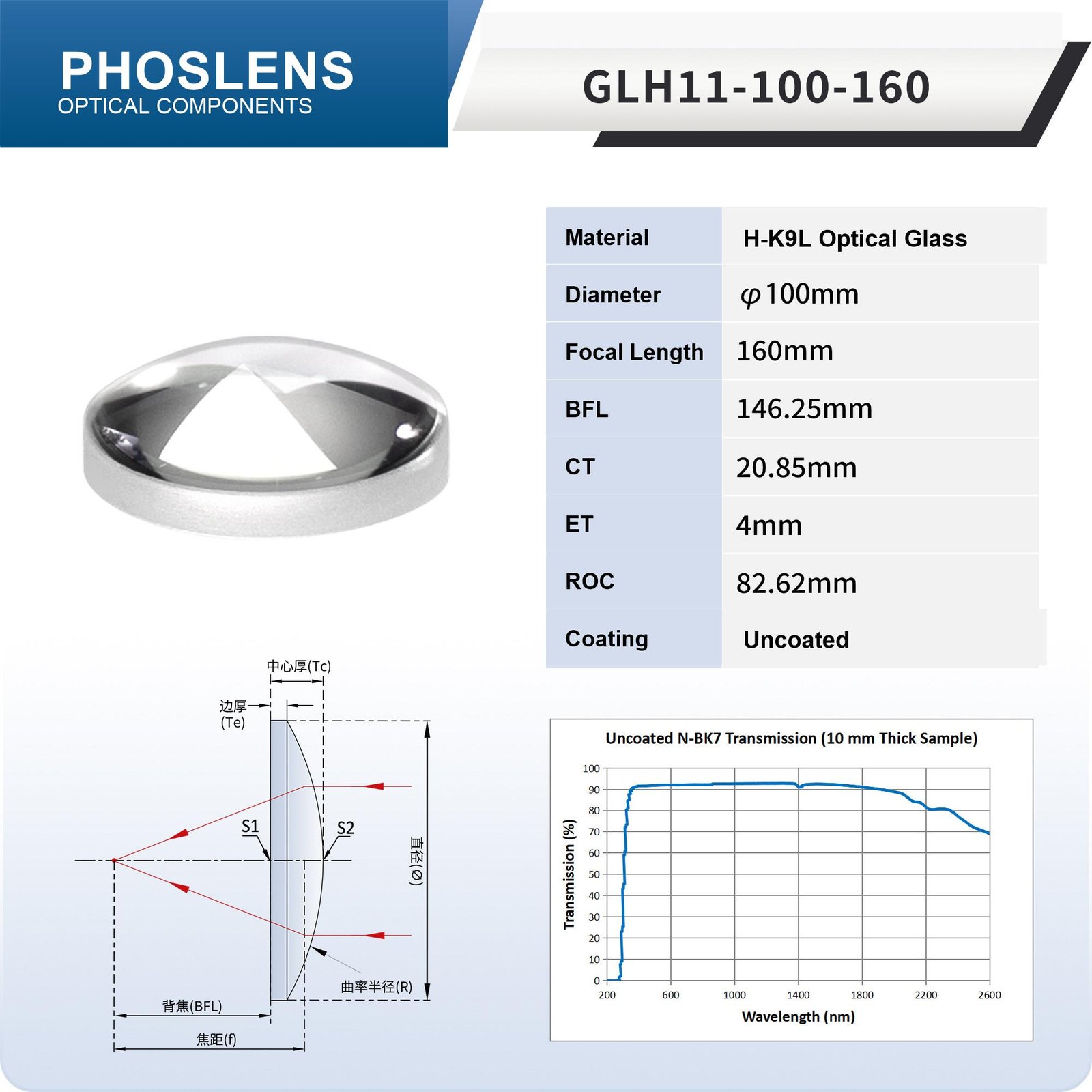
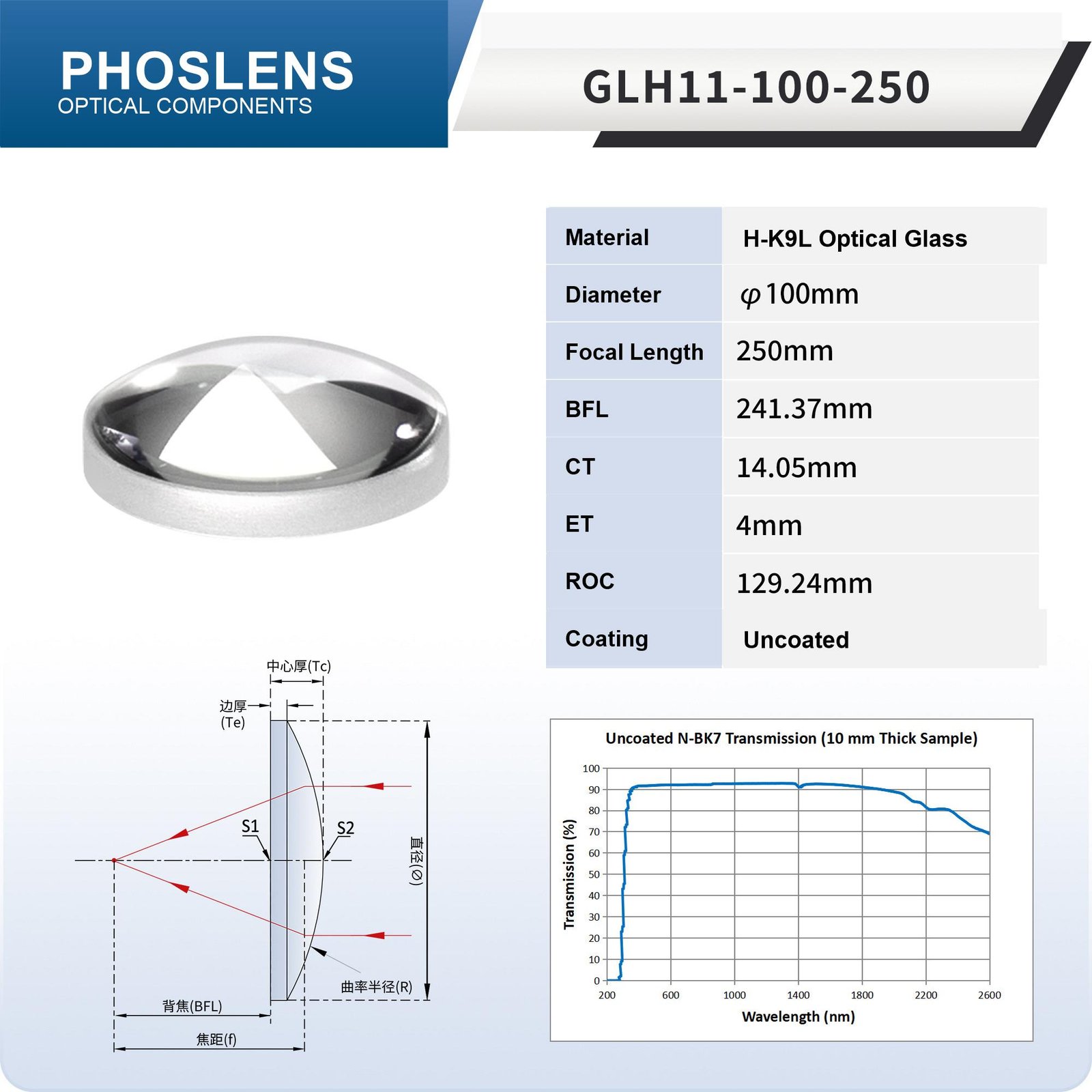
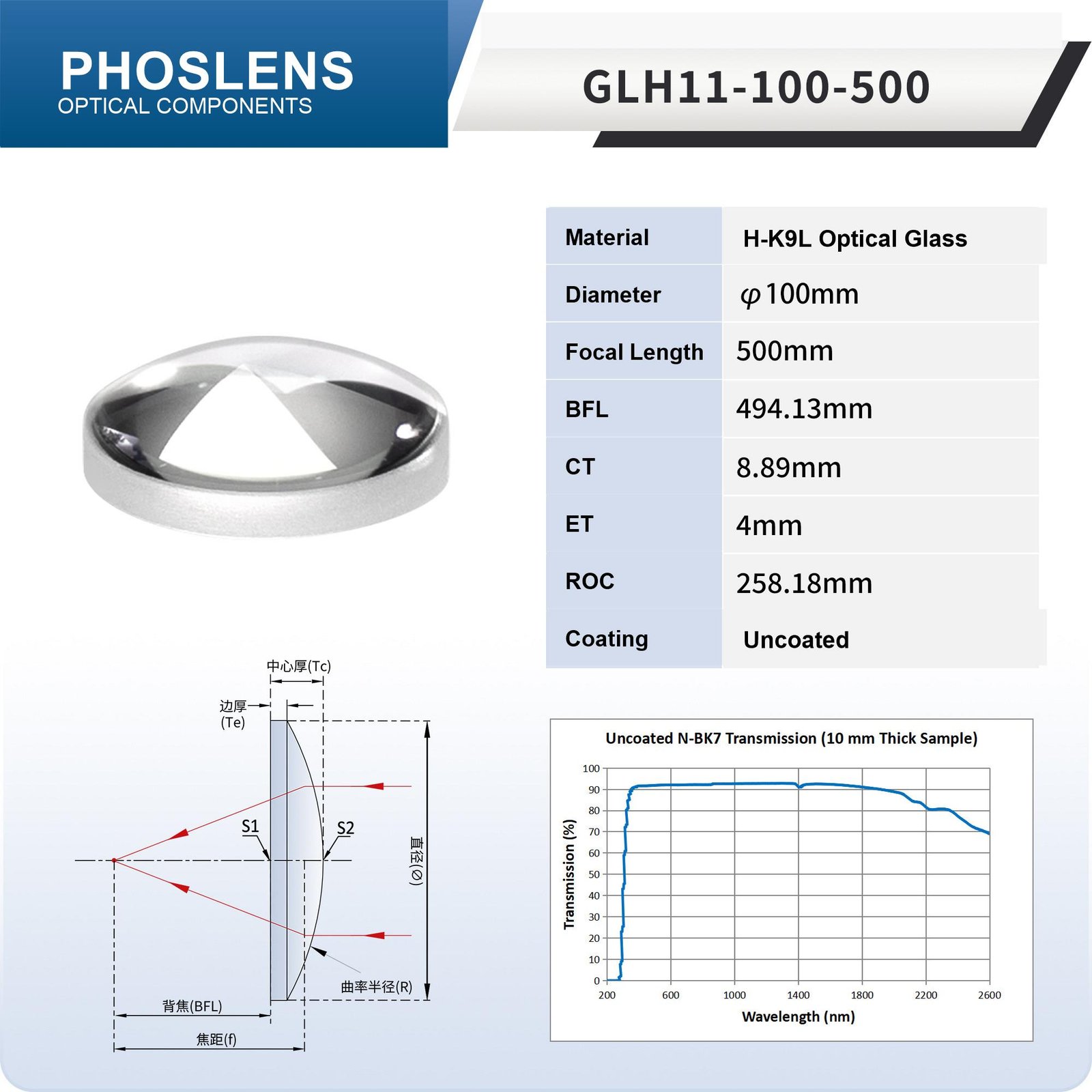
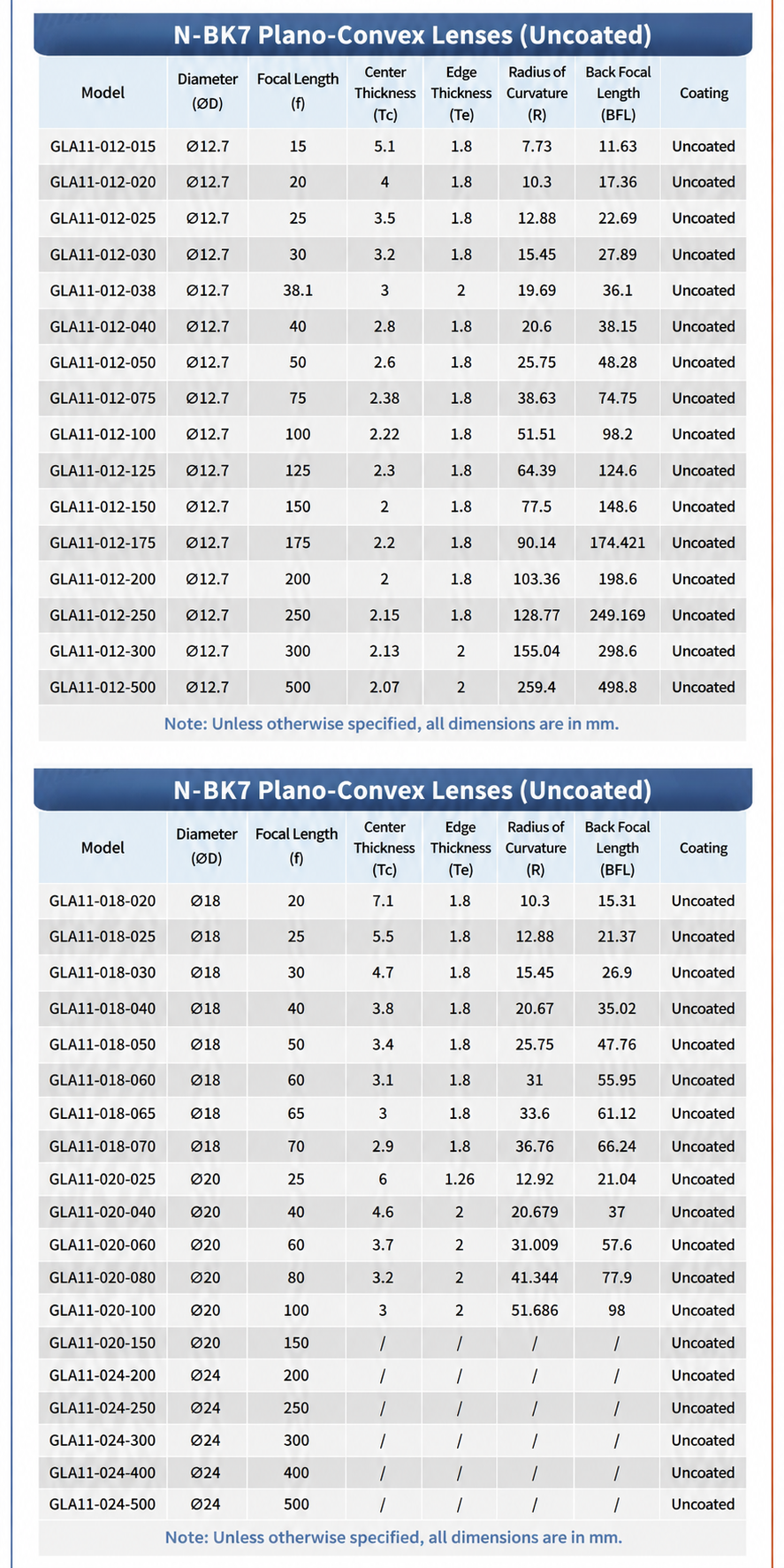
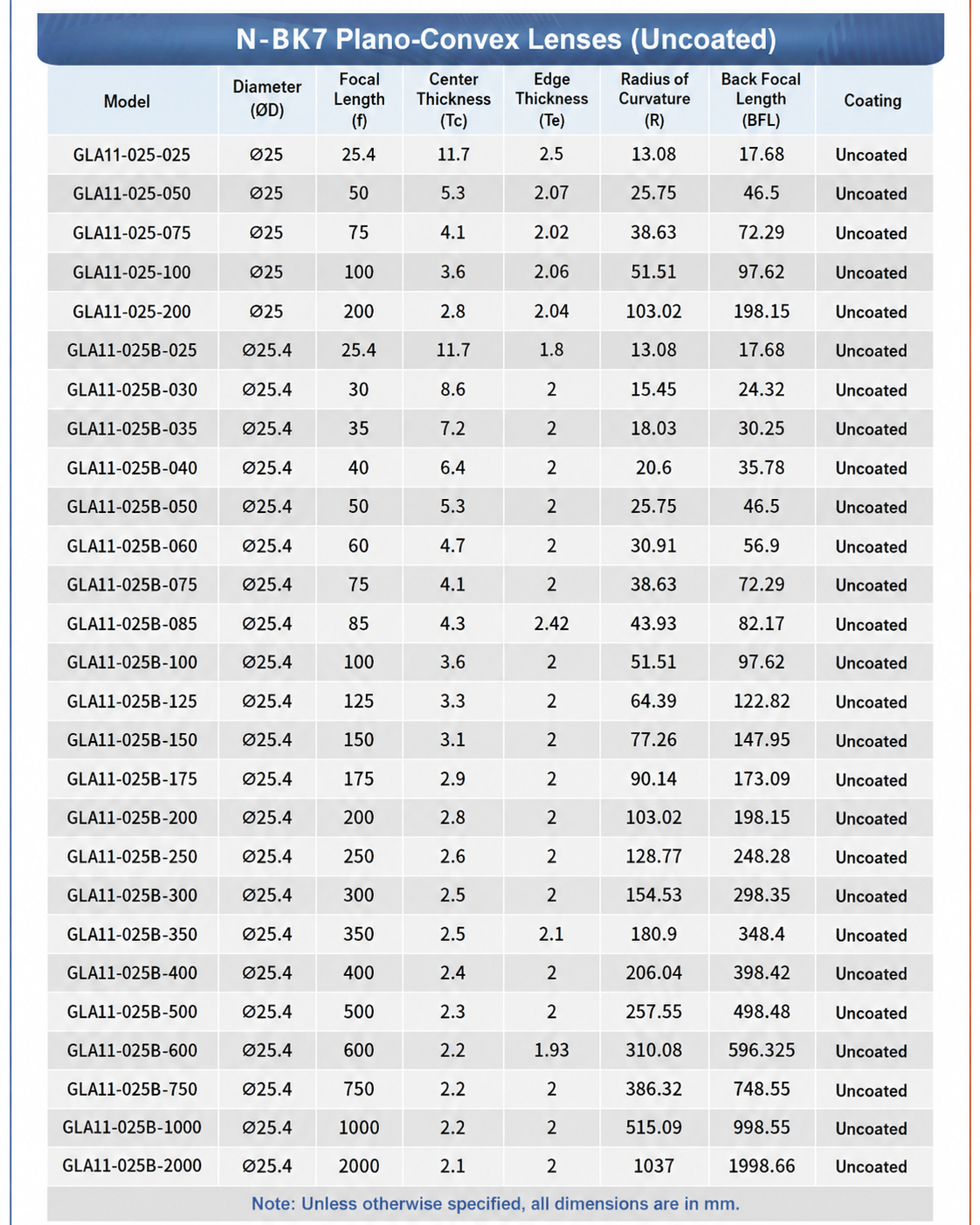
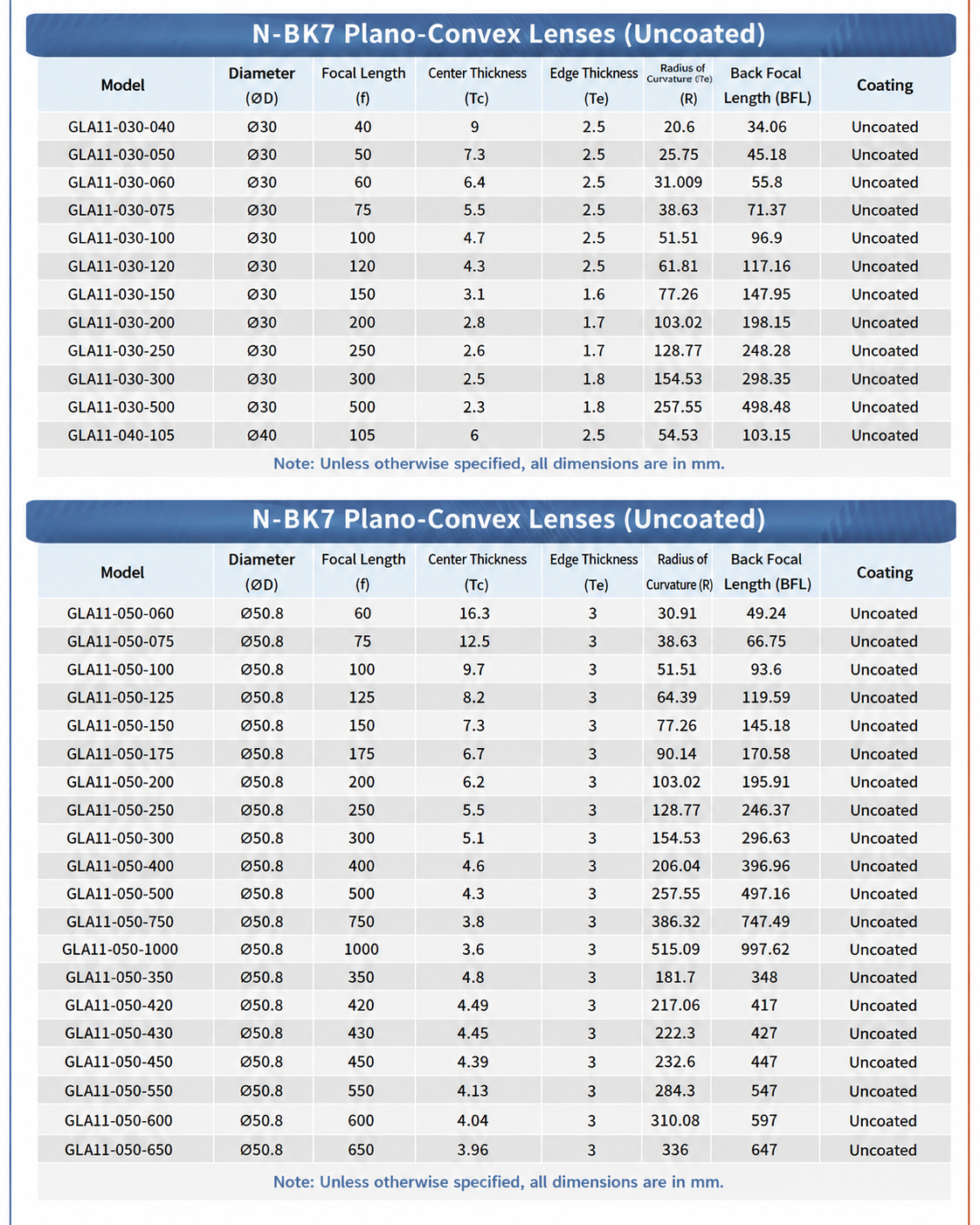
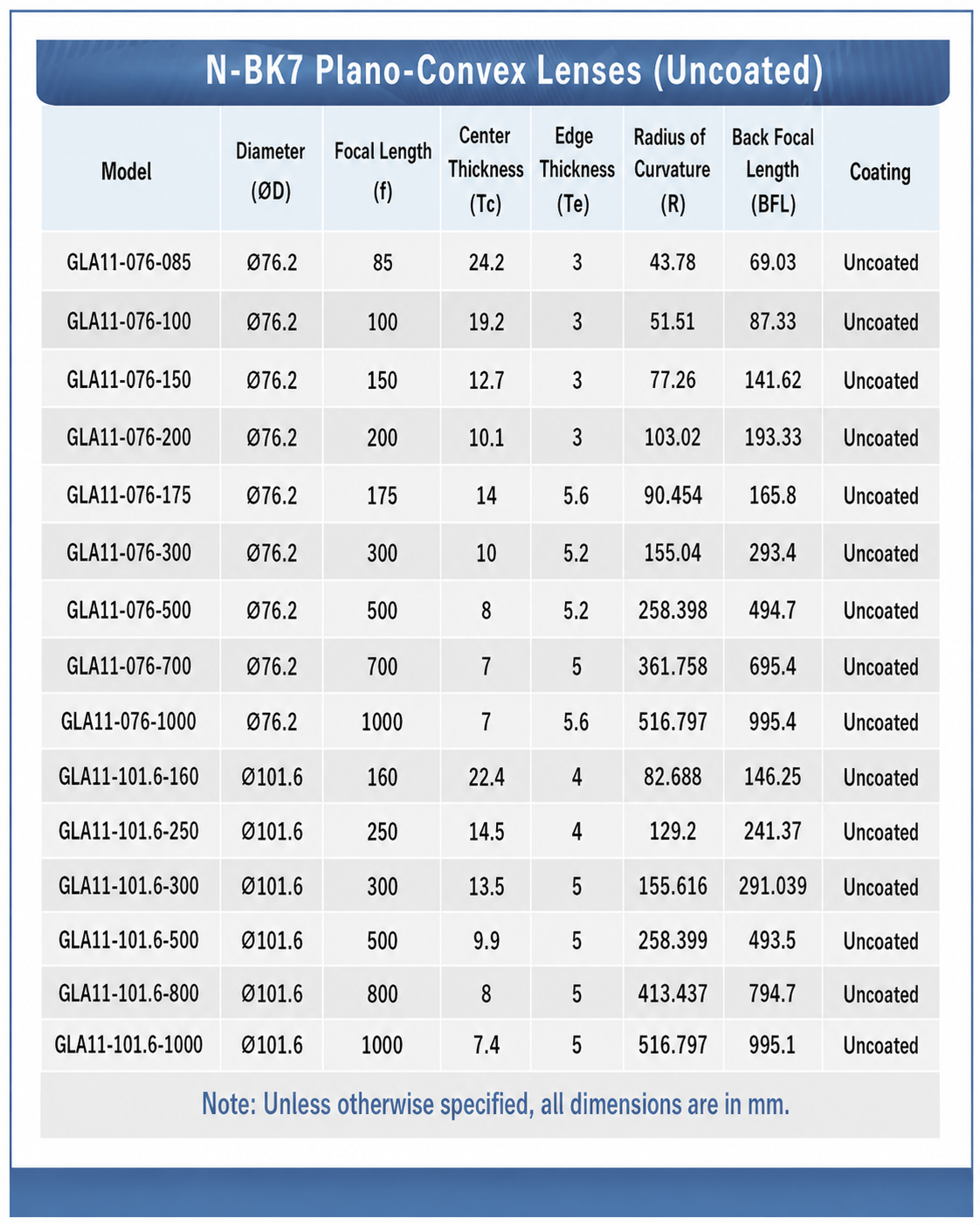
Model Specification Tables
The following specification tables provide model-level dimensional data for standard uncoated plano-convex
lenses. Unless otherwise specified, all dimensions are in millimeters.
Typical Applications
- Focusing collimated light beams
- Collimating light from point sources
- Beam expansion
- Reducing beam divergence
- Optical alignment
- Laboratory optical setups
- Imaging systems
- Laser systems
- Optical testing and measurement
- Optomechanical assemblies
Custom Options
If the standard models do not meet your project requirements, PHOSLENS can support custom plano-convex
lens sourcing by RFQ. Please provide the required material, diameter, focal length, coating, wavelength
range, quantity and application details for quotation.